
October 21, 2026
Short answer: When you buy a new home before selling the one you own, a lender’s main question is whether you can carry both at once. By default, they count both mortgage payments — your current home and the new one — in your debt-to-income ratio, which can shrink how much you qualify to borrow. The good news: there are well-established ways to get your current payment set aside, from a signed sale contract on your old home to a buy-before-you-sell program like the Knock Bridge Loan™ that removes the departing mortgage from the math entirely.
Why your current home matters to a lender
When you apply for a mortgage, the lender measures your debt-to-income ratio — your total monthly debt payments divided by your gross monthly income. The Consumer Financial Protection Bureau explains debt-to-income ratio as exactly that comparison, and it’s the first thing underwriting looks at. (Our guide to how DTI works breaks it down further.)
Here’s the catch for a move-up buyer: your current home doesn’t disappear from that calculation just because you plan to sell it after you move. Until it’s sold — or handled a specific way — the lender assumes you’re responsible for its full housing payment, often written as PITIA: principal, interest, taxes, insurance, and any HOA dues. Stack your current PITIA on top of your proposed new payment, plus car loans, student loans, and credit cards, and your DTI can climb past what the loan program allows.
That’s the whole reason buying before selling feels harder than it should — not that you can’t afford the next home, but that on paper you look like you’re carrying two.
The three ways lenders treat your current mortgage
How your current payment gets counted comes down to what you can document about the home you’re leaving.
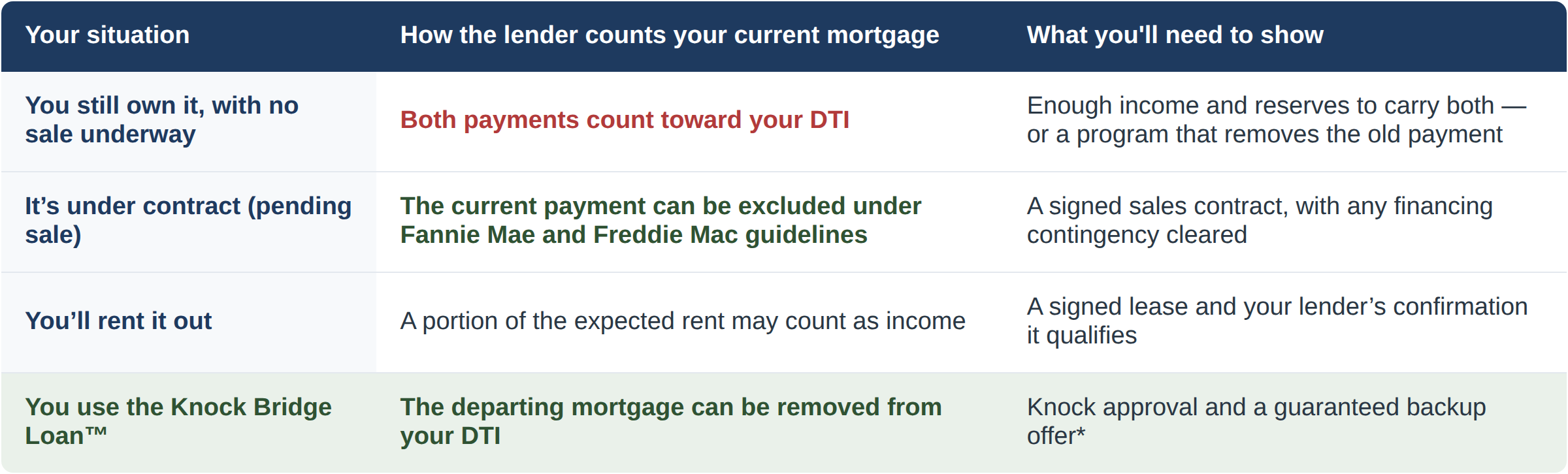
The pending-sale rule is the one most buyers don’t know about: under conventional Fannie Mae and Freddie Mac guidelines, if your current home is under contract but won’t close before your new loan funds, the lender can leave its payment out of your DTI — but only if your file includes an executed sales contract and proof that any financing contingency has been cleared. No signed contract, and both payments stay in.
What you’ll need to show your lender
Whichever path fits, underwriting is a documentation exercise. If you still own another home when you apply, expect the lender to ask for some combination of:
A current pre-approval that accounts for both properties, so there’s no surprise later.
Proof of reserves — months of housing payments in savings — in case your old home takes longer to sell than planned.
The sales contract for your current home, if it’s under contract, plus confirmation the financing contingency is cleared.
A signed lease and rental documentation, if you’re converting the home to a rental.
Bridge or equity financing terms, if you’re using a program to cover the down payment or remove the old payment.
A clean file is also what lets you make a non-contingent offer — one that isn’t “subject to selling my current home” — which sellers take far more seriously. See what a non-contingent offer requires for why that matters in a competitive market, and how lenders handle buyers who haven’t sold for the underwriting view your loan officer works from.
How the Knock Bridge Loan™ helps
Most of the friction above comes from one problem: your money and your qualifying power are both locked inside a home you haven’t sold yet. The Knock Bridge Loan™ is built to unlock both.
It gives you access to up to $1,000,000 of your equity at 0% interest, with no payments for up to six months, so you can fund your down payment and buy your next home before the old one sells.
Knock Bridge Loan Plus can remove your departing mortgage from your debt-to-income ratio — the single biggest thing holding move-up buyers back — so carrying your current home doesn’t shrink what you qualify for on the next one.
If your old home doesn’t sell within six months, the guaranteed Knock Purchase Offer buys it at a price agreed up front,* so you’re never stuck carrying two homes indefinitely. In practice, 92% of Knock customers sell their home in under 90 days.
The result is the position every buyer wants and few can prove on their own: approved for the new home, not counting two mortgages, and able to make a strong, non-contingent offer. For the bigger picture, our complete guide to buying before you sell walks through the whole process.
Frequently asked questions
Can I get a mortgage if I haven’t sold my current house? Yes. Lenders approve buyers who still own a home all the time — the question is whether you qualify while carrying both housing payments. If your income and reserves support both, you’re fine; if not, getting the old payment excluded (via a sale contract, a lease, or a buy-before-you-sell program) is what makes it work.
Will my current mortgage count against me? By default, yes — your current home’s full payment counts in your debt-to-income ratio until the home is sold or handled a specific way. That’s the main reason move-up buyers qualify for less than they expect.
How do I get my current mortgage excluded from DTI? There are three common routes: a signed sales contract on your current home with the financing contingency cleared; a signed lease if you’re renting it out; or a program like Knock Bridge Loan Plus that removes the departing mortgage from your DTI.
Do I need to sell before I make an offer on a new home? No. With the right financing in place, you can make a non-contingent offer and close on your new home before your current one sells — then sell on your own timeline.
How much will a lender let me borrow while I still own a home? It depends on your income, your debts, and how your current mortgage is treated. Removing the old payment from your DTI — by selling, renting, or using a program built for it — is usually what increases how much you can borrow.
Key takeaways
Until your current home sells, lenders generally count both mortgage payments in your debt-to-income ratio, which can limit what you qualify for.
You can get the current payment excluded with a signed sale contract (contingency cleared), a signed lease, or a buy-before-you-sell program.
Expect to document a current pre-approval, reserves, and proof of your plan for the old home.
The Knock Bridge Loan™ unlocks your equity and can remove your departing mortgage from DTI, so owning a home you haven’t sold doesn’t stand between you and the next one.
Ready to see how much you could qualify for before you sell? Check your eligibility with Knock in a few minutes.
* The Knock Purchase Offer is a written, non-contingent offer from Knock Property 1, LLC to buy your home at an agreed price. Knock Property 1, LLC — a wholly-owned subsidiary of Knock Lending LLC (NMLS #1958445) — is the entity that makes the Knock Purchase Offer and that would purchase the home. You are not required to use Knock Lending or any Knock affiliate.