
October 15, 2026
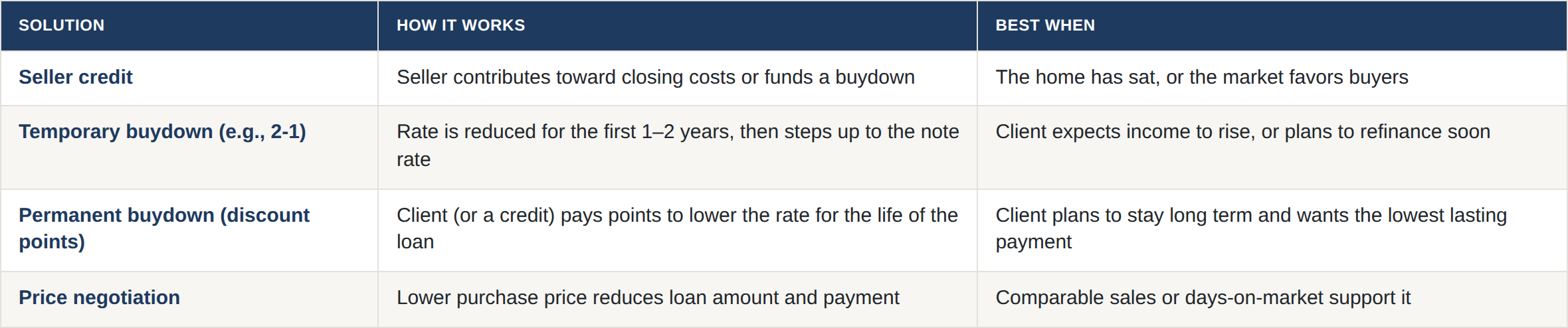
Short answer: When a client is stuck on the rate, the strongest move is to offer a concrete way to lower the payment. The main tools are seller credits (the seller contributes toward closing costs or a buydown), temporary buydowns (a lower rate for the first year or two), and permanent buydowns (discount points that lower the rate for the life of the loan). Knowing when to reach for each turns a rate objection into a solvable problem.
Options beat objections
A client who says “the rate is too high” is really saying “the payment feels too high.” That’s a problem you can solve with structure rather than argument. Payment solutions — seller credits and buydowns — let you lower the client’s monthly cost without waiting for the market to move. The loan officers who win in a higher-rate environment are the ones who walk in with options, not just quotes. For the broader framing, see the rate-conversation playbook and making the payment make sense.
The main payment solutions
Each tool lowers the payment in a different way, and each fits a different client and market.
The CFPB explains discount points — upfront money that lowers the rate — and how lender and seller credits work, which is a useful, neutral resource to share with clients who want to understand the mechanics.
How to put them to work
The art is matching the tool to the client. A buyer who expects a raise or plans to refinance may prefer a temporary buydown that eases the first couple of years. A buyer settling in for the long haul may get more value from a permanent buydown. And in a market where listings are sitting, a seller credit is often available for the asking — sellers frequently care more about a clean, certain close than about a small price change, so a credit toward a buydown can be an easy win for both sides. (The next post in this series digs into temporary vs. permanent buydowns so you can pick the right one for each client — look for it next week.)
Position these as a package, not a last resort. When you open with “here are three ways we can bring your payment down,” you’ve already changed the conversation from whether to buy to how to structure it.
Frequently asked questions
Who pays for a buydown? It depends. A temporary buydown is often funded by a seller credit; a permanent buydown (points) is usually paid by the buyer, though a seller or lender credit can cover it. The funding source is part of your negotiation strategy.
Are seller credits always available? No — they depend on the market and the specific listing. They’re most common when a home has been on the market a while or when inventory favors buyers. It never hurts to ask.
Is a temporary buydown just delaying the problem? Not if it’s matched to the client’s plan. It works when the client reasonably expects higher income or intends to refinance before the rate steps up. It’s a poor fit if neither is true.
How do I explain this without overwhelming the client? Lead with the payment impact, not the mechanics: “This option lowers your payment by about this much for the first two years.” Share the CFPB resource for clients who want the detail.
Give your clients options that make the payment work. Explore Knock for loan officers, or revisit the rate-conversation playbook.