
October 20, 2026
Short answer: A temporary buydown lowers your client’s rate for the first year or two, then steps up to the note rate — ideal when they expect income to rise or plan to refinance soon. A permanent buydown uses discount points to lower the rate for the entire loan — ideal when they’re staying long term and want the lowest lasting payment. The right choice depends on the client’s timeline, cash, and plans, not on which sounds better.
Two tools, two different jobs
Both buydowns lower the payment, but they solve different problems. A temporary buydown is about the near term: it eases the first one to two years when a move, a career ramp, or new homeownership costs are straining cash flow. A permanent buydown is about the long term: it trades upfront money (discount points) for a lower rate and payment every month for as long as the client keeps the loan. Confusing the two — or defaulting to whichever the client heard about first — is how good options get wasted. This builds directly on the seller credits and buydowns overview; here we go a level deeper.
How they compare
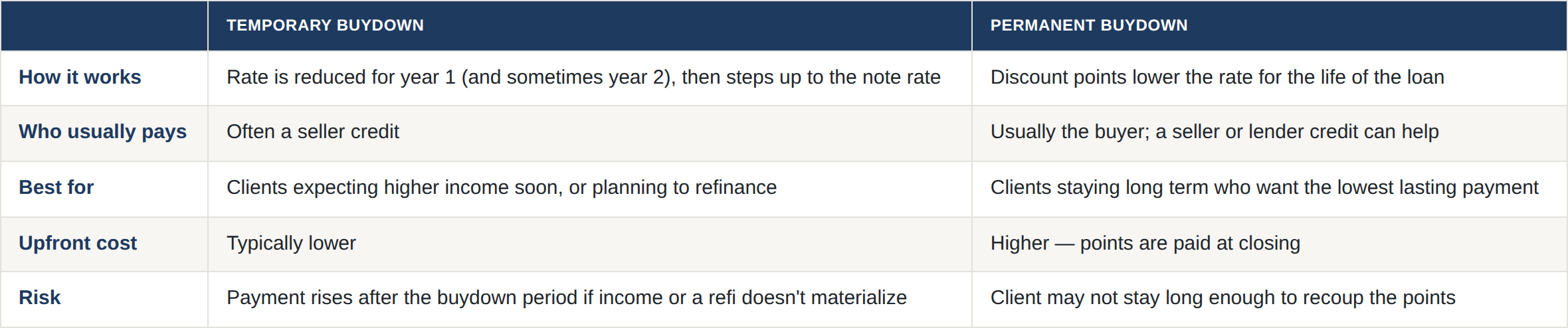
The CFPB’s explanation of discount points and credits is a clear, neutral reference to share when a client wants to understand the trade-off between paying upfront and paying monthly.
How to decide with your client
Ask three questions. How long do they plan to stay? The longer the horizon, the more a permanent buydown can pay off. What do they expect to happen with their income? A rising path favors a temporary buydown that eases the early years. How much cash do they have at closing, and where’s it best spent? Points compete with down payment and reserves. Walk through the break-even — how long it takes a permanent buydown’s monthly savings to recoup the upfront points — so the client sees the math, not just the pitch. Keep the focus on the payment they’ll live with, the same way you would in making the payment make sense.
For the full set of rate-conversation moves, see the loan officer’s playbook.
Frequently asked questions
Which buydown is “better”? Neither in the abstract. A temporary buydown is better for a client who needs early relief and expects things to improve; a permanent buydown is better for a long-term owner who wants the lowest lasting payment. Match the tool to the plan.
Can a seller fund either one? A seller credit most commonly funds a temporary buydown, but it can also go toward points for a permanent buydown. The funding source is part of your negotiation.
What’s the break-even on a permanent buydown? Divide the cost of the points by the monthly savings to see how many months it takes to recoup. If the client plans to stay well past that point, it often makes sense.
What happens at the end of a temporary buydown? The rate steps up to the full note rate, so the payment rises. Make sure the client is prepared for that number — it’s the whole reason the “expects income to rise or will refinance” condition matters.
Help your clients choose the buydown that fits their plan. Explore Knock for loan officers, or revisit seller credits and buydowns.