
October 29, 2026
Short answer: The best response to a rate objection isn’t a counterargument — it’s a question that surfaces the real concern, followed by a concrete option. Acknowledge the client’s point, pivot to the payment, and offer a specific next step. This post pulls the whole Rate Check-in series together into ready-to-use talk tracks you can adapt to your own voice.
The pattern behind every good response
Every one of these talk tracks follows the same three beats: acknowledge, pivot, offer. Acknowledge the client’s concern so they feel heard. Pivot from the rate to the number or goal that actually drives the decision. Offer a specific, concrete next step — a payment estimate, a buydown option, an equity conversation. Arguing skips the first beat and loses the client; this pattern keeps them with you. It’s the applied version of everything in the rate-conversation playbook.
Talk tracks for the common objections
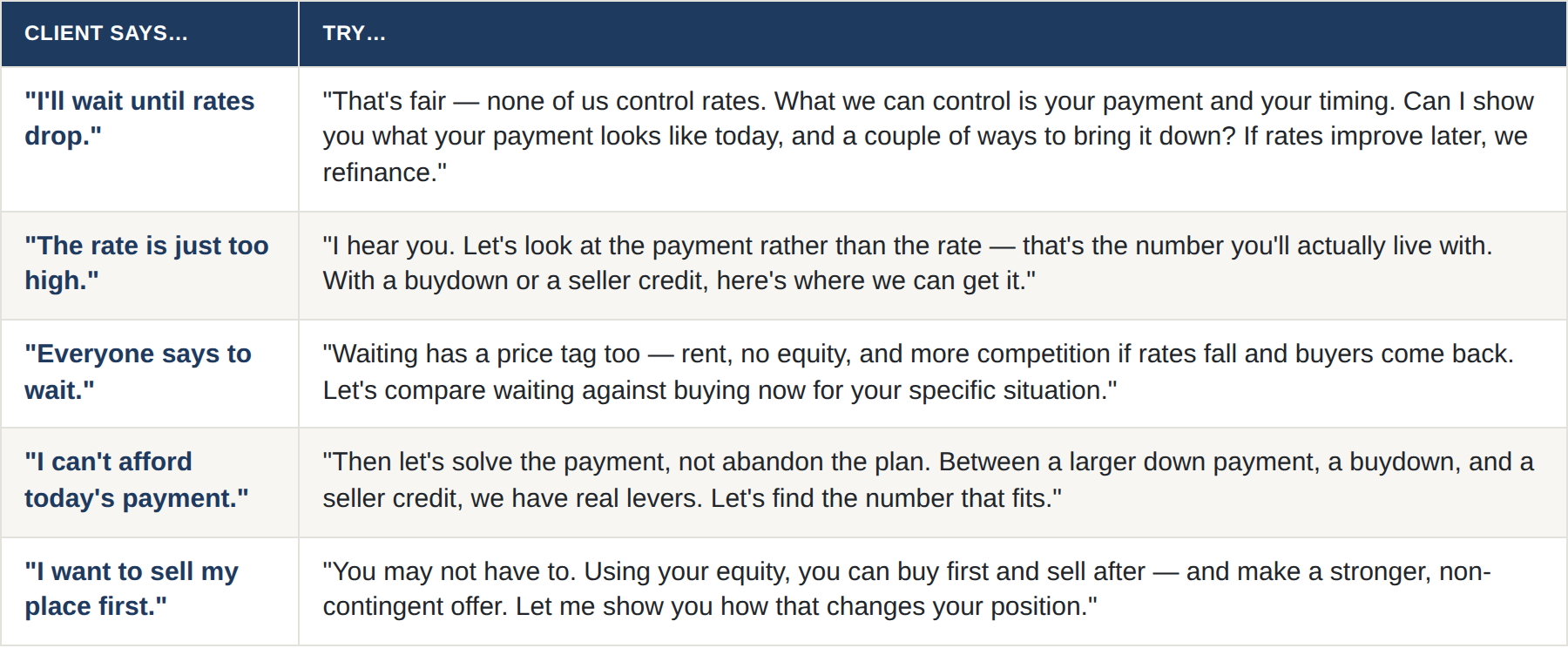
Adapt these to your voice — the structure matters more than the exact words.
Pull the whole series together
Each talk track maps to a tactic from this series. “Show you the payment” is making the payment make sense. “Waiting has a price” is weighing waiting vs. buying now. “A buydown or a seller credit” is payment solutions and choosing the right buydown. “Use your equity to buy first” is helping move-up clients use equity strategically. And the overarching move — lifting the client above the rate entirely — is reframing around goals, timing, and total opportunity.
That last talk track is worth emphasizing: for a move-up client, unlocking equity to buy before selling — with a guaranteed backup offer if their home doesn’t sell* — is often the single most powerful answer to “I’ll wait,” because it removes the real fear behind the objection.
Frequently asked questions
What’s the one thing not to do? Don’t argue the rate head-on. It makes the client defensive and keeps the conversation on the number you can’t change. Acknowledge, pivot, offer.
How do I know which talk track to use? Listen for the real concern. “Too high” is a payment problem; “everyone says wait” is a timing problem; “sell first” is a structure problem. Match the response to the concern.
Do these work over text and email, not just in person? Yes — the acknowledge/pivot/offer structure works in writing. Keep it short, lead with empathy, and end with a specific next step.
What if the client still wants to wait after all this? Then respect it, stay in touch, and keep the door open. A client who feels heard comes back when they’re ready — and they’ll come back to you.
Equip yourself to win the rate conversation all month long. Explore Knock for loan officers, or start the series at the rate-conversation playbook.
* The Knock Purchase Offer is a written, non-contingent offer from Knock Property 1, LLC to buy your home at an agreed price. Knock Property 1, LLC — a wholly-owned subsidiary of Knock Lending LLC (NMLS #1958445) — is the entity that makes the Knock Purchase Offer and that would purchase the home. You are not required to use Knock Lending or any Knock affiliate.